
Injection Molding Design for Manufacturability Checklist
- Precision Machining Tolerance Verification Guide
- Injection Molding Design for Manufacturability Checklist
- Additive Manufacturing Structural Integrity Assessment
- Material Selection and Durability Evaluation Protocol
- Prototype-to-Production Transition Readiness Manual
- Functional Assembly Fit and Clearance Validation Kit
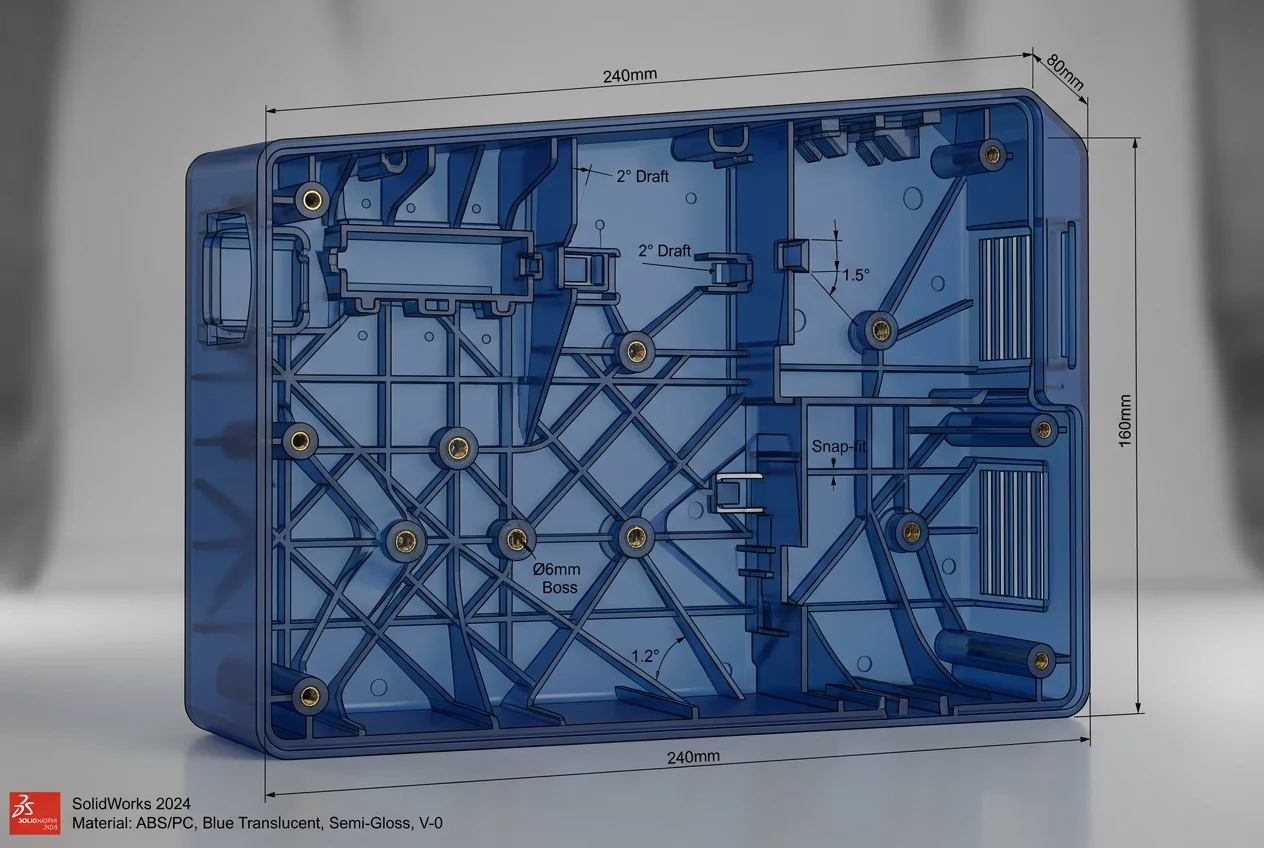
Injection Molding Design for Manufacturability Checklist
Optimizing Designs for High-Volume Plastic Production
Transitioning from a 3D-printed prototype to an injection-molded product is a significant milestone that requires a fundamental shift in design thinking. Injection molding introduces constraints related to fluid dynamics, thermal cooling, and mechanical ejection that do not exist in additive manufacturing. A robust Design for Manufacturability (DFM) approach ensures that parts can be produced consistently, quickly, and without defects like warping or sink marks. This guide serves as a roadmap for engineers looking to refine their geometries for the realities of the mold tool.
The Golden Rule: Uniform Wall Thickness
Consistency in wall thickness stands as the most critical factor in successful injection molding. When plastic cools inside a mold, thicker sections take longer to solidify than thinner ones, leading to internal stresses and surface depressions known as sink marks. Designers should strive to maintain a uniform thickness throughout the part. If a design requires varying thicknesses, gradual transitions are necessary to allow the molten plastic to flow smoothly. PartPass Field Guide recommends keeping walls within the range of 1.2mm to 3mm for most thermoplastic materials to balance structural integrity with efficient cooling cycles.
Implementing Effective Draft Angles
Every vertical surface on a molded part must have a slight taper, known as a draft angle, to allow for easy removal from the mold. Without these angles, the part will scrape against the steel walls of the tool as it is ejected, causing cosmetic damage or even sticking. A standard draft angle of 1 to 2 degrees is typically sufficient for most parts, though textured surfaces may require significantly more to prevent the grain from catching. Incorporating these tapers early in the design phase prevents the need for expensive mold modifications later on. It is a simple geometric change that has a massive impact on production reliability.
Reinforcing with Ribs and Bosses
Instead of increasing wall thickness to add strength, engineers should use ribs. Ribs provide structural rigidity while maintaining thin walls, which keeps cooling times low and material usage efficient. A well-designed rib should be roughly 50% to 70% of the thickness of the main wall to prevent sink marks on the opposite side. Similarly, bosses used for fasteners should be connected to the outer walls with gussets to ensure stability. Proper ribbing and boss design allow for lightweight yet incredibly strong components that stand up to the rigors of end-use applications.
Strategic Gate and Vent Placement
The location where the molten plastic enters the mold—the gate—determines the strength and appearance of the final part. Placing gates in non-cosmetic areas is preferred, as they leave a small scar when removed. Furthermore, air trapped inside the mold must have a way to escape through vents. Poor venting leads to 'burn marks' where compressed air heats up and scorches the plastic. Collaborating with mold makers to optimize these flow paths ensures that the part fills completely and consistently, reducing the rate of rejects and improving the overall surface finish of the production run.